Performance comparability between AZDye and Alexa Fluor® dyes for fluorescent based applications.
Tech Note
Nikita Savelyev & Erika Leonard
Vector Laboratories Inc, 6737 Mowry Ave, Newark, CA 94560
Nikita Savelyev & Erika Leonard
Vector Laboratories Inc, 6737 Mowry Ave, Newark, CA 94560
Alexa Fluor® dyes have been the gold standard for unconjugated fluorophores over the past couple of decades. Vector Laboratories has developed the AZDye brand of fluorophores, which are structurally equivalent and show comparable performance to the Alexa Fluors, but at a fraction of the cost, for process economy in fluorescent based applications including immunofluorescence (IF), ELISA, FISH, flow cytometry, next generation sequencing and qPCR. The following article details the experiments conducted to show the performance comparability between both brands.
Sulfonated fluorescent dyes or fluorophores have revolutionized the field of fluorescence labeling, offering numerous advantages over traditional dyes like fluorescein and rhodamines. These benefits include superior water solubility, higher fluorescence intensity, reduced self-quenching, enhanced photostability, and lower pH sensitivity1. The Alexa Fluor® family of dyes, developed in the late 1990s and now a registered trademark of Thermo Fisher Scientific, has long been considered the gold standard in this category.
However, with the expiration of original patents covering Alexa Fluor® dyes, Vector Laboratories has developed and commercially introduced AZDyes, which are structurally identical to Alexa Fluor® dyes but offer significant cost savings. On average, AZDyes are 2.5 times less expensive per milligram compared to their Alexa Fluor® counterparts. In depth experimentation was done to show the performance comparability of AZDyes relative to Alexa Fluors.
To assess the relative performance of AZDyes (AZDye 350-NHS ester FP-1002, AZDye 488-NHS ester FP-1013, AZDye 555-NHS ester FP-1166, AZDye 594-NHS ester FP-1646, AZDye 647-NHS ester FP-1121, all from Vector Laboratories), we conducted a comprehensive comparison with selected Alexa Fluor® dyes (Alexa Fluor® 350-NHS ester cat# A10168, Alexa Fluor® 488-NHS ester cat# A20000, Alexa Fluor® 555-NHS ester cat# A20009, Alexa Fluor® 594-NHS ester cat# A20004, Alexa Fluor® 647-NHS ester cat# A20006, all from Thermo Fisher Scientific) at specific nm wavelengths of 350, 488, 555, 594, and 647, respectively. Dye-NHS esters were conjugated with Goat anti-Mouse IgG using different NHS:IgG ratios to achieve degree-of-labeling (DOL) values within the optimal range for each Alexa fluorophore. These AZDyes and Alexa Fluor® conjugates were then compared side-by-side in two different antibody-based detection systems: ELISA and immunofluorescence (IF) in tissue.
The following protocols were used to prepare reagents and test the performance comparability between the fluorophores.
Materials:
Also Used: 5 mL HiTrap Desalting Column on ÄKTA avant™ chromatography system
Preparation of IgG solution:
Preparation of dye-NHS ester conjugate:
Determination of DOL and concentration:
Dilute an aliquot of the purified conjugate with PBS to fit into the optimal range of your UV-Vis spectrophotometer (2x in most cases). Measure absorbance at 280 nm and at the dye’s maximum absorption wavelength using a UV-Vis spectrophotometer. Calculate the degree of labeling (DOL) and protein concentration using the formulas below:
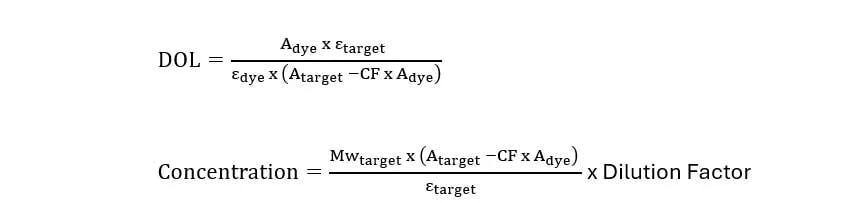
εdye – extinction coefficient of the dye
εtarget – extinction coefficient of the biomolecule
Adye – absorbance maximum of the dye
Atarget – absorbance maximum of the protein (280 nm)
CF – correction factor for the protein at 280 nm
Materials:
Procedure:
Data:
A.
B.
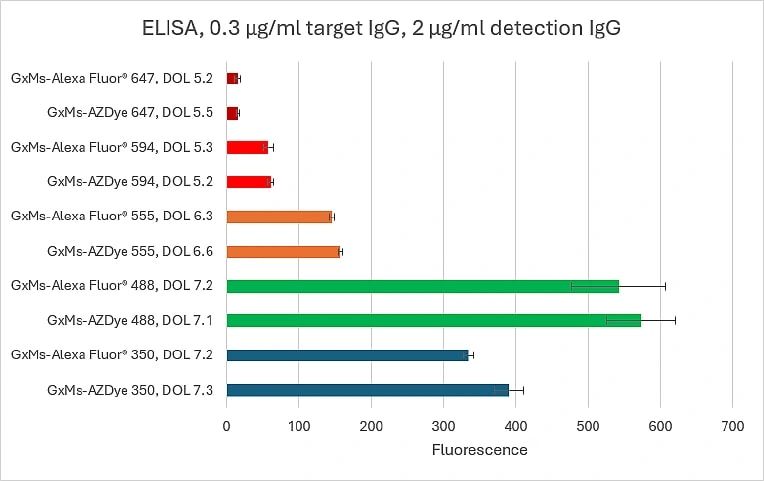
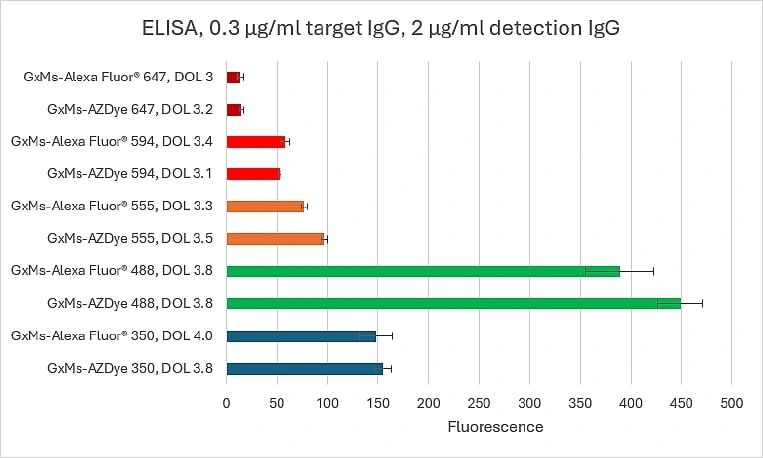
Figure 1: AZDye and Alexa Dye conjugates show equivalent intensity of fluorescence at similar degree of labeling (DOL) in direct ELISA.
A. Absolute fluorescence intensity for Goat x Mouse IgG-dye conjugates at lower end of the optimal DOL range.
B. Absolute fluorescence intensity for Goat x Mouse IgG-dye conjugates at higher end of the optimal DOL range.
Materials:
Procedure
Procedure:
Image Acquisition:
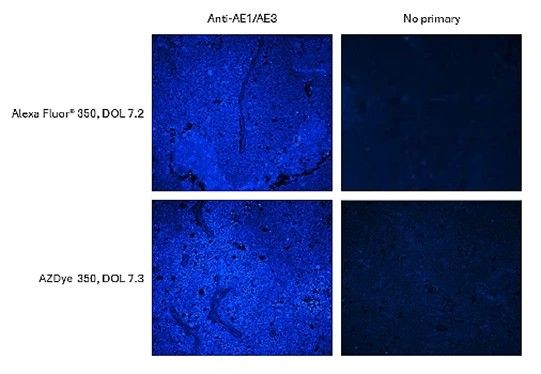
Figure 2: AZDye and Alexa Fluor® Dye conjugates show equivalent intensity of fluorescence and background staining at similar degree of labeling (DOL) in immunofluorescence analysis of bowel carcinoma tissue sections. The primary antibody used was Mouse anti-AE1/AE3 at 3.27 µg/ml and secondary antibody was Goat anti-Mouse-dye conjugates at 1 µg/ml. 20x magnification, 500ms exposure.

Figure 3: AZDye and Alexa Fluor® Dye conjugates show equivalent intensity of fluorescence and background staining at similar degree of labeling (DOL) in immunofluorescence analysis of bowel carcinoma tissue sections. The primary antibody used was Mouse anti-AE1/AE3 at 3.27 µg/ml and secondary antibody was Goat anti-Mouse-dye conjugates at 1 µg/ml. 20x magnification, 50ms exposure.
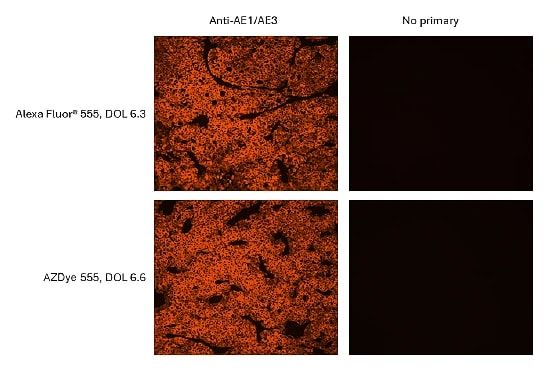
Figure 4: AZDye and Alexa Fluor® Dye conjugates show equivalent intensity of fluorescence and background staining at similar degree of labeling (DOL) in immunofluorescence analysis of bowel carcinoma tissue sections. The primary antibody used was Mouse anti-AE1/AE3 at 3.27 µg/ml and secondary antibody was Goat anti-Mouse-dye conjugates at 1 µg/ml. 20x magnification, 80ms exposure.

Figure 5: AZDye and Alexa Fluor® Dye conjugates show equivalent intensity of fluorescence and background staining at similar degree of labeling (DOL) in immunofluorescence analysis of bowel carcinoma tissue sections. The primary antibody used was Mouse anti-AE1/AE3 at 3.27 µg/ml and secondary antibody was Goat anti-Mouse-dye conjugates at 1 µg/ml. 20x magnification, 50ms exposure.

Figure 6: AZDye and Alexa Fluor® Dye conjugates show equivalent intensity of fluorescence and background staining at similar degree of labeling (DOL) in immunofluorescence analysis of bowel carcinoma tissue sections. The primary antibody used was Mouse anti-AE1/AE3 at 3.27 µg/ml and secondary antibody was Goat anti-Mouse-dye conjugates at 1 µg/ml. 20x magnification, 70ms exposure.
Our comprehensive evaluation revealed that AZDyes perform equivalently to Alexa Fluor® dyes in their performance in bioconjugation reactions, as well as in the conjugate performance in intended use workflows.
AZDyes were conjugated to Goat anti-Mouse IgG using the same protocol as Alexa Fluor® dyes. The degree of labeling (DOL) achieved was equivalent between AZDyes and Alexa Fluor® dyes, indicating similar conjugation efficiency. In addition, conjugate yields were comparable. AZDye conjugates showed comparable performance to Alexa Fluor® conjugates in ELISA assays. Signal intensity and background levels were similar for both dye families across the tested wavelengths (350, 488, 555, 594, and 647 nm). In tissue immunofluorescence studies, AZDye conjugates again demonstrated performance equivalency to Alexa Fluor® conjugates. Images captured using a Nikon Eclipse fluorescence microscope showed similar fluorescence intensity, signal-to-noise ratio, and overall image quality for both dye families. Specific staining patterns were observed for various cellular structures (e.g., cytokeratin) with both AZDye and Alexa Fluor® conjugates. Exposure times used for imaging were the same for corresponding AZDye and Alexa Fluor® conjugates, indicating similar brightness.
AZDyes are a valuable tool in the field of fluorescent labeling, offering performance equivalence to Alexa Fluor® dyes at a fraction of the cost. Their superior optical and physical properties, combined with their broad spectral coverage, make AZDyes an excellent choice for researchers seeking high-quality, cost-effective fluorescent labels. The comparable performance of AZDyes in ELISA and tissue immunofluorescence analysis demonstrates their potential to replace Alexa Fluor® dyes in various applications without compromising performance.
AZDyes are available with a wide range of reactive groups, allowing researchers to select the most appropriate chemistry for their specific bioconjugation needs. This flexibility in reactive group options ensures that AZDyes can be easily integrated into diverse experimental workflows, accommodating different biomolecules and conjugation strategies.
As the field of fluorescence microscopy continues to evolve, AZDyes are poised to play a crucial role in advancing scientific discovery across multiple disciplines, enhancing research capabilities in the life science, diagnostic, and biopharma communities. The combination of cost-effectiveness, performance, and versatility in bioconjugation chemistry – positions AZDyes as a valuable tool for researchers pushing the boundaries of fluorescence-based techniques.